
Engineering Change Management (ECM) is one of the most critical, high-impact functions in any automotive or industrial OEM. Every design update — from a minor feature enhancement to a safety-critical modification — flows through the ECN pipeline. Yet, for many OEMs, this process becomes a bottleneck due to workload surges, distributed teams, legacy systems, cross-functional approvals, and the sheer volume of documentation.
This is where a high-maturity Engineering Services partner can take complete ownership of the ECN process, delivering end-to-end execution, digital governance, and engineering-grade quality — all while freeing OEM teams to focus on innovation and core product strategy.
Below is a comprehensive perspective on how an Engineering Services organization can manage the entire ECN lifecycle for an OEM.
A typical ECN process in automotive/Aero/industrial sectors involves:
1. Change Identification
– Field issues (warranty, service feedback)
– Manufacturing challenges
– Cost reduction proposals
– Supplier change impacts
– Design enhancement requests
2. Change Evaluation
– Feasibility review
– CAD impact study
– Interface and packaging analysis
– FEA/CAE validation (if required)
– Tooling & manufacturing impact
3. Change Documentation
– ECN form preparation
– Updated BOM, part lists, and revision tables
– CAD model revisions
– 2D drawing releases
– DFM/DFA checks
4. Change Approval Workflow
– Cross-functional IQA review
– Manufacturing, sourcing, and supplier approval
– Program management sign-off
5. Release & Implementation
– PLM update
– Version control
– Communication to suppliers & manufacturing
– Validation of implemented changes
An engineering partner can take over all these steps with a structured, SLA-driven approach.
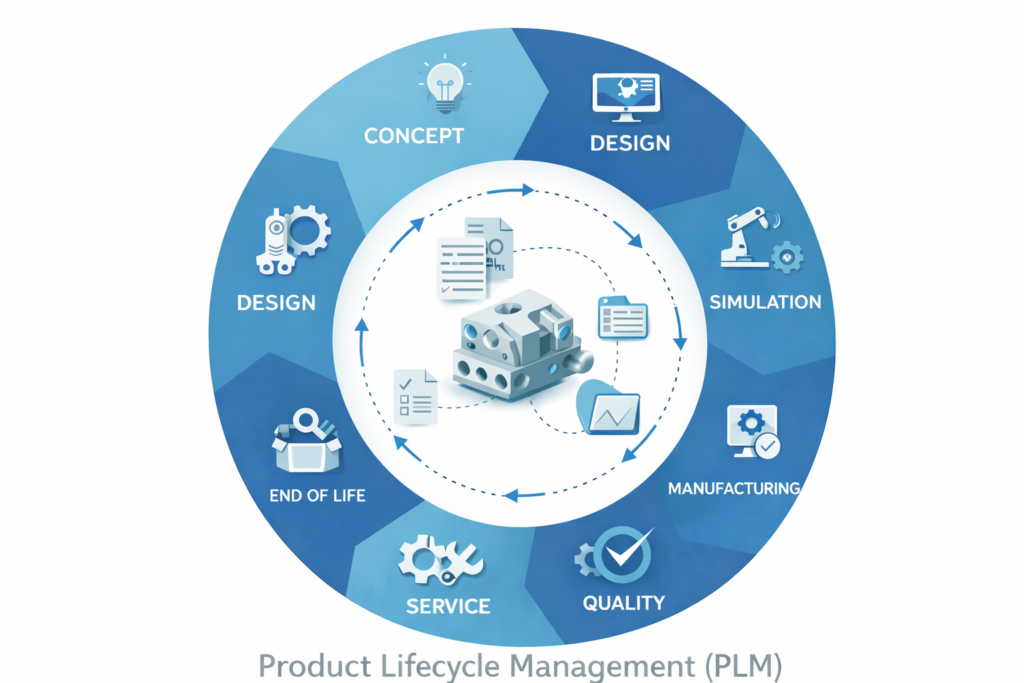
A. Centralized ECN Governance Cell
Partner establish a dedicated ECN Governance Cell that works as an extended digital team of the OEM.
Responsibilities:
• ECN intake and numbering
• Prioritization based on urgency (Safety / Regulatory / Cost / Program Timing)
• Daily monitoring of open changes
• Weekly dashboards to OEM stakeholders
• SLA management and escalation control
This ensures continuity, visibility, and predictable cycle times.
B. Complete CAD Ownership for Changes
Partners CAD team’s handle:
• 3D model updates
• Parametric feature control
• Master section updates
• Clash & packaging validation
• Assembly regeneration
• Detailed drawing revisions
• GD&T updates
• Tolerance stack-up validation
Every change is captured with traceability to ensure engineering accuracy and audit readiness.
C. Simulation & Validation Support (Where Required)
For changes that impact performance:
• CAE revalidation (Structural, NVH, Fatigue, Thermal, Crash evaluations)
• FEA delta analysis
• Simulation correlation with baseline data
• Performance-risk assessment report
This ensures that every change maintains engineering integrity.
D. Complete Documentation Control
Document management includes:
• Revision-controlled 2D drawings
• BOM change logs
• Controlled ECN documents
• ERP/PLM updates (Teamcenter, Windchill, Enovia, Arena PLM etc.)
• Release notification packets
• Supplier communication documents
OEM documentation standards are followed with 100% compliance.
A successful ECN process requires seamless coordination with:
• Manufacturing engineering
• Quality teams
• Supplier development
• Procurement
• Program management
• Homologation & regulatory teams
• Service & warranty groups
Partners governance model includes:
• RACI matrices
• Weekly CFT review calls
• Digital Kanban boards
• Automated reminders & approval workflows
• Traceability from request → decision → release
This reduces ambiguity and brings discipline to the entire lifecycle.
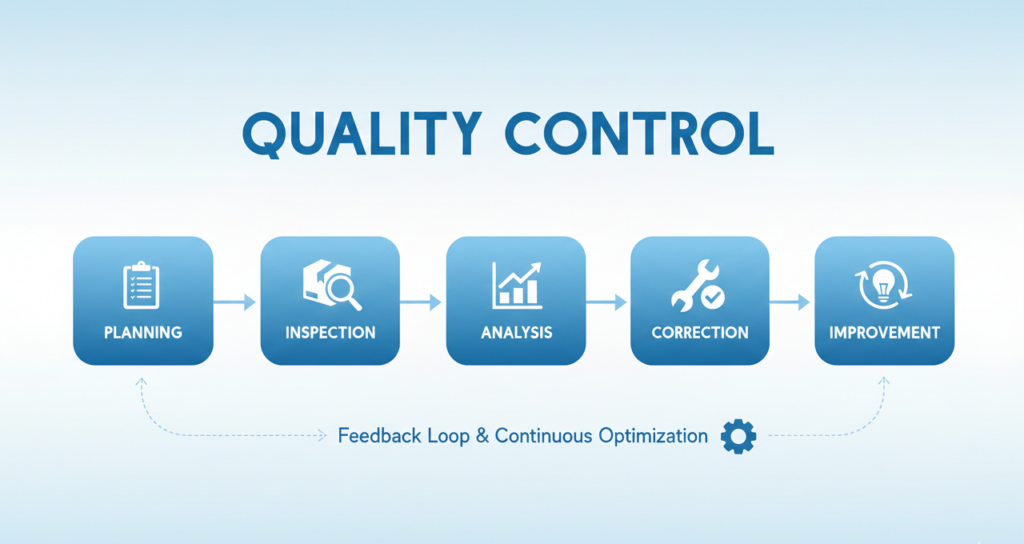
Layered Quality Model
1. Self-check by executing engineer
2. Peer review (CAD & documentation)
3. Technical lead validation
4. Final ECN QA gate using digital checklists
5. OEM alignment check
Quality Metrics Tracked
• ECN first-time-right (FTR) %
• Cycle time per ECN
• Rework rate
• Documentation accuracy index
• Packaging/Interface error leakage rate
• Baseline vs. delta performance accuracy (for simulation-related changes)
This ensures every ECN is released with production-grade quality.
1. Massive Productivity Improvement
OEM internal teams focus on:
• NPD
• Advanced engineering
• Next-generation technologies
• Safety programs
Partner take care of the ECN volume work.
2. Faster Cycle Time & Program Stability
ECN bottlenecks are eliminated → smoother production schedules.
3. Reduced Cost & Overhead
No need to scale permanent engineering teams for fluctuating change loads.
4. Guaranteed Quality and Traceability
Every change is controlled, validated, and documented to OEM standards.
5. Scalable to Multi-Program & Multi-Plant Deployments
Partner support regional/global ECN processes across trims, variants, and model years.
• Years of CAD/PLM/CAE domain expertise
• Experience handling thousands of ECNs
• Onsite-offshore hybrid delivery
• Certified PLM experts
• Automated tools for error detection, BOM comparison & model audits
• Proven leadership in design change management
• Strong confidentiality & IP protection framework
Partners don’t just execute changes — they ensure design integrity, functional performance, and regulatory compliance for every release.
When OEMs delegate ECN ownership to a capable engineering services partner, they gain:
✔ A controlled, predictable, governed change process
✔ Engineering accuracy with zero-compromise quality
✔ Faster release cycles
✔ Lower program disruptions
✔ A digital, audit-ready change management system
In today’s competitive world, engineering speed and precision are everything.
With end-to-end ECN execution, Partner help OEMs maintain design safety, ensure manufacturability, and unlock productivity, without adding internal complexity.